Liquidity & Funding Simulator · LFS-3 · 28 October 2026
Sell £100,000. Borrow Less. Keep Your Cash Reserve?
A partial sale can cut a collateral repayment demand sharply. The useful question is how much to sell to preserve the cash reserve - and what investment exposure you give up.
The same payment. A different funding mix.
A fictional company needs £300,000 now. It owns a £1.5 million investment portfolio, holds £150,000 cash and wants to keep at least £100,000 available. A separate £400,000 net receipt is expected in month 12.
In the previous case, the company borrowed the whole £300,000. A 60% portfolio fall and a reduction in the lending percentage to 35% triggered £90,000 of additional principal repayment. Cash fell below the chosen reserve.
Now compare that plan with selling £100,000 of investments at the outset and borrowing £200,000. The sale proceeds fund part of the payment; they are not also added to the cash reserve. Both plans start with the same £150,000 cash after funding the payment.
| Opening position | Borrow the full amount | Partial sale + loan |
|---|---|---|
| Payment funded | £300,000 | £300,000 |
| Investments sold | £0 | £100,000 |
| Loan | £300,000 | £200,000 |
| Investments retained | £1,500,000 | £1,400,000 |
| Cash / chosen reserve | £150,000 / £100,000 | £150,000 / £100,000 |
Both loans carry 7% nominal annual interest, paid monthly. Initial lending value is 50% of the remaining portfolio. The horizon is 24 months. Tax, fees, investment growth, dividends, cash interest and other net cash flows are excluded in the downside tests. The common £300,000 purchase is outside both closing positions.
What if 1: the portfolio falls 60% before the receipt arrives?
In month 6, reduce the remaining portfolio by 60% and the lending percentage from 50% to 35%. Keep the loan interest rate unchanged. These are deliberately severe stress assumptions, not a prediction or quoted lender terms.
| Month-6 collateral test | Full loan | £100k sale + loan |
|---|---|---|
| Portfolio after the fall | £600,000 | £560,000 |
| Debt before the collateral repayment | £300,000 | £200,000 |
| Supported debt at 35% | £210,000 | £196,000 |
| Additional principal repayment | £90,000 | £4,000 |
| Cash after interest, before that repayment | £139,500 | £143,000 |
| Cash after that repayment | £49,500 | £139,000 |
The mixed plan has less collateral because some investments were sold. It would be incorrect to apply 35% to the original portfolio. Even after allowing for that smaller collateral pool, reducing debt by £100,000 lowers the repayment demand by £86,000.
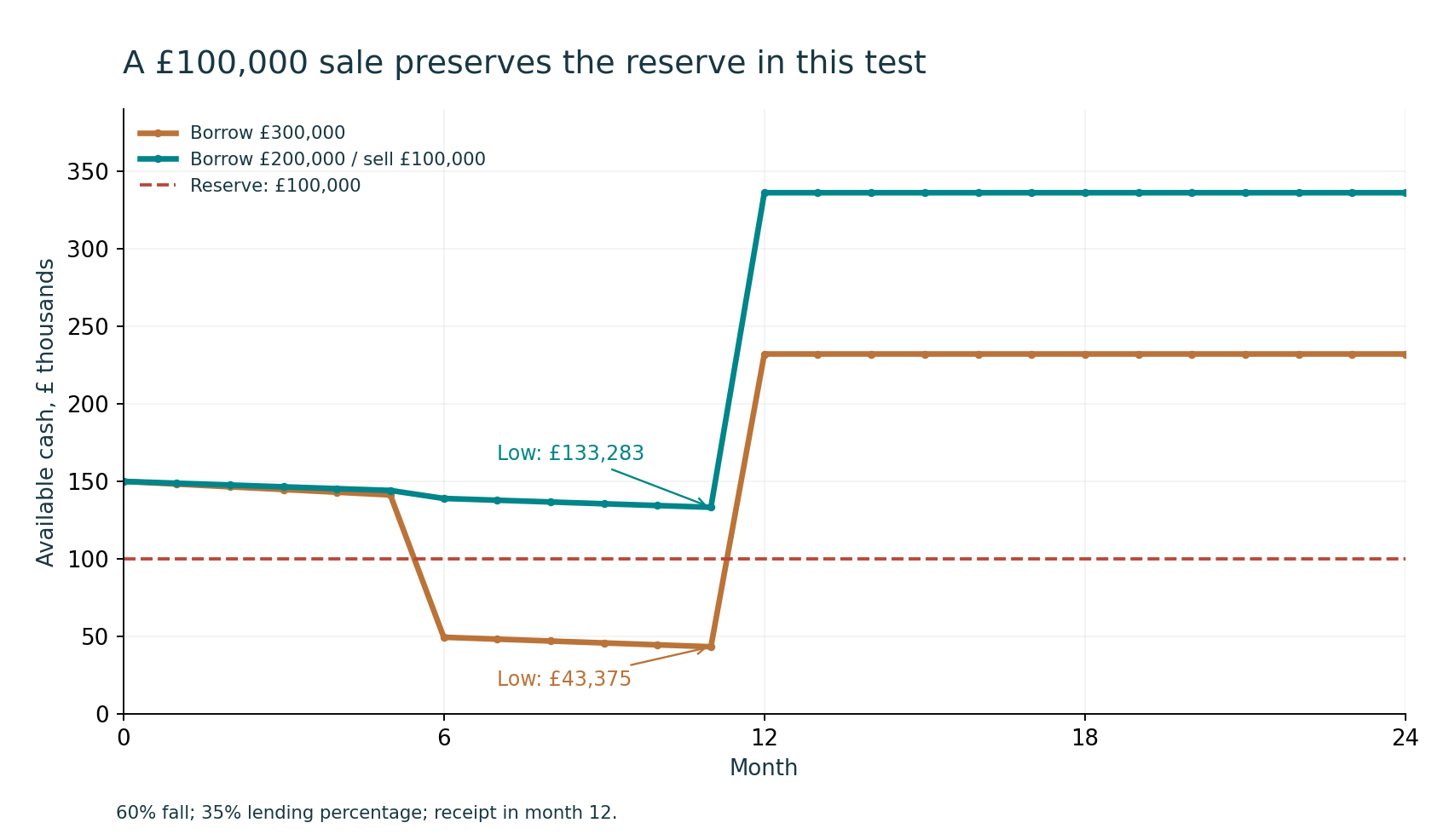
The full-loan plan reaches a low of £43,375 in month 11. The mixed plan reaches £133,283 in the same month, preserving the reserve with about £33,283 of headroom. In month 12, the receipt repays the remaining debt in both plans.
| At month 24 | Full loan | £100k sale + loan |
|---|---|---|
| Total interest paid | £17,850 | £13,860 |
| Cash after interest and all principal repayments | £232,150 | £336,140 |
| Remaining investments / debt | £600,000 / £0 | £560,000 / £0 |
| Cash if all remaining investments are sold; before tax | £832,150 | £896,140 |
The mixed plan ends £63,990 ahead in this particular falling-market path. £60,000 comes from avoiding the assumed 60% loss on the £100,000 sold at the start; £3,990 comes from lower interest. That difference is conditional on this path. The £90,000 and £4,000 repayments are principal, not extra expenses: each reduces cash and debt equally.
What if 2: the fall is 75% and the receipt is six months late?
Increase the month-6 fall to 75% and move the receipt from month 12 to month 18. Keep the stressed lending percentage at 35%. This combines a bigger collateral shock with a longer funding period.
The £100,000 sale now fails the reserve test. Add a third plan: sell £150,000 and borrow £150,000. This leaves £1.35 million invested before the shock and £337,500 afterwards.
| Harder-test result | Full loan | Sell £100k | Sell £150k |
|---|---|---|---|
| Opening loan | £300,000 | £200,000 | £150,000 |
| Month-6 repayment demanded | £168,750 | £77,500 | £31,875 |
| Cash after the repayment actually made | £0 | £65,500 | £112,875 |
| Uncovered collateral demand | £29,250 | £0 | £0 |
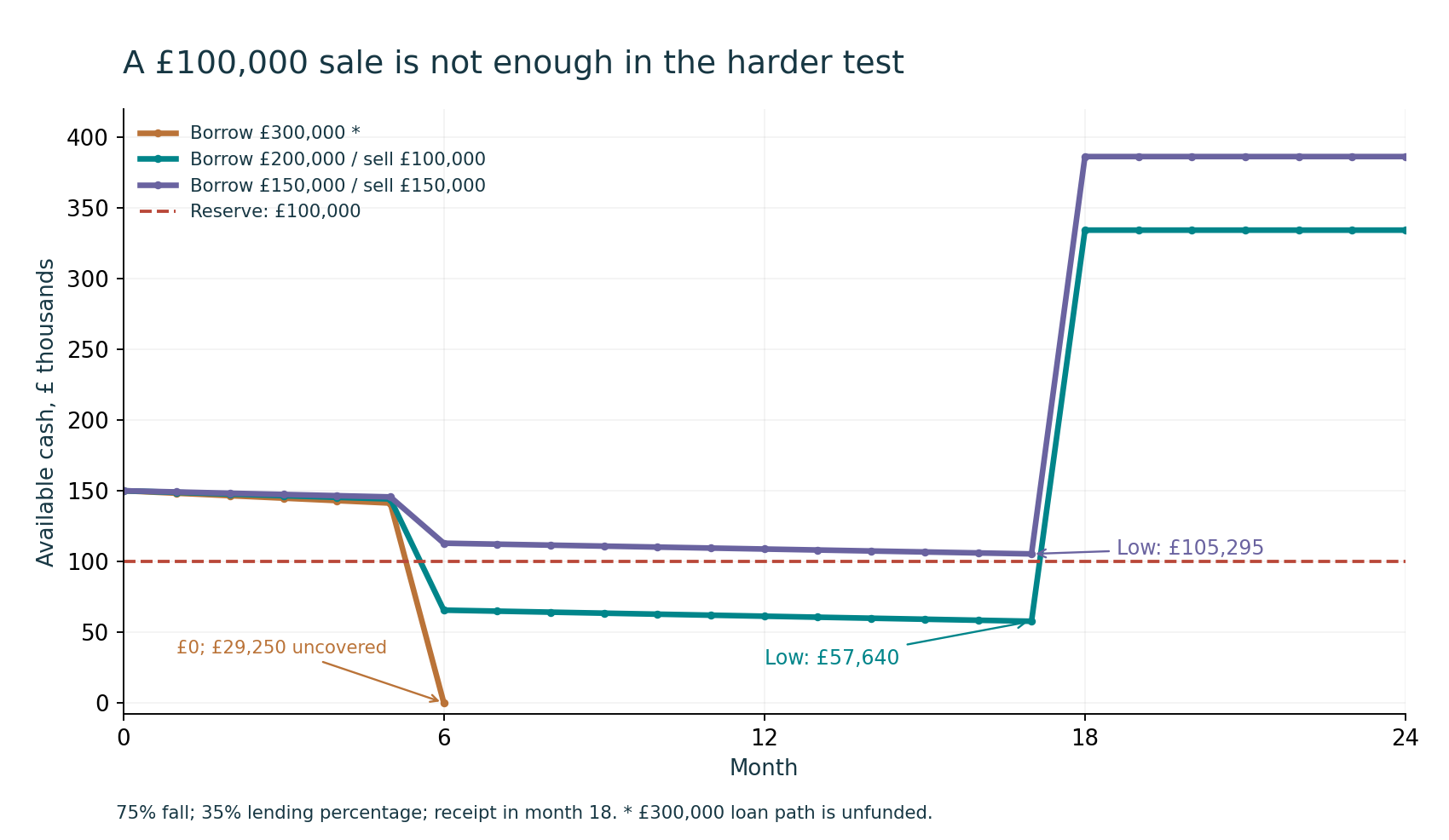
| Lowest opening/month-end cash on a funded path | Not funded | £57,640 (m. 17) | £105,295 (m. 17) |
| Total interest on a funded path | Not presented | £15,575 | £13,519 |
| Month-24 cash / remaining investments | Not presented | £334,425 / £350,000 | £386,481 / £337,500 |
| Month-24 cash after selling remaining investments; before tax | Not presented | £684,425 | £723,981 |
Selling £150,000 preserves the reserve in this test, with only about £5,295 of headroom. Selling £100,000 covers the collateral demand but does not preserve the reserve. These are different outcomes. The full loan exhausts all cash and leaves £29,250 uncovered in month 6; without new funding or another action, month-7 interest makes cash negative.
For orientation, keeping the fall at 60% but delaying only the receipt gives minimum cash of £126,423 with the £100,000 sale, compared with £36,025 under the full loan. The more severe fall, not merely the delay, is what defeats that mixed plan here.
The protection has an opportunity cost
A sale reduces debt and future collateral exposure. It also gives up the future performance of the assets sold. The downside results cannot establish that selling is always the better investment decision.
As a separate upside illustration, remove the price shock and lending-value reduction, keep the receipt in month 12, and assume steady 6% annual capital growth for 24 months. With the same 7% loan rate and no tax or fees, full borrowing ends at £1,914,400 after selling the remaining investments and repaying the loan, versus £1,909,040 for the £100,000 mixed plan. Full borrowing is £5,360 ahead: the extra £100,000 retained earns £12,360, exceeding £7,000 of extra interest.
This is an assumed return path, not a forecast or a return hurdle that guarantees liquidity. A favourable endpoint cannot fund an earlier collateral demand. Tax on an initial sale, asset selection, transaction costs and actual lender terms can also change the comparison.
Choose a funding mix against a cash constraint
The useful output is not a universal “sell £100,000” recommendation. It is a comparison of the sale size, opening debt, stressed collateral demand, minimum cash and remaining investments under the scenarios that matter.
In this example, a £100,000 sale is enough for the 60% fall, including a six-month receipt delay. It is insufficient for the combined 75% fall and delay. A £150,000 sale passes that harder test narrowly. Different assumptions can produce a different answer.
Before borrowing against investments, decide which cash would meet an early repayment demand without consuming the reserve you still need.
Try the comparison in Liquidity & Funding Simulator
Open the free simulator. Enter the common assumptions above. In the combined plan, set cash used to £0 and net sale proceeds to £100,000; compare Borrow with Combine under Combined stress. Set portfolio fall to 60%, stressed lending percentage to 35%, shock month to 6, receipt delay to 0 and stress-rate increase to 0. Keep tax off and capital growth at 0.
Then change the portfolio fall to 75%, receipt delay to 6 and net sale proceeds to £150,000. Case files are provided for the £100k sale / 60% fall, the £100k sale / harder test and the £150k sale / harder test. Load a saved case and select Combined stress.
Method, boundaries and sources
LFS 1.2.0; one entity and one currency. Loans fund the same payment. Sales occur at the start, before the hypothetical fall, and reduce the assets available as collateral. Interest is paid monthly before the month-end receipt. Available cash cures collateral shortfalls even when that consumes the reserve. No automatic forced sale, emergency loan or overdraft is assumed. Displayed amounts are rounded; calculations use unrounded amounts.
Tax is excluded throughout, including in final sale values. A tax-enabled mixed plan needs enough gross sale proceeds to cover the entered disposal tax as well as the payment contribution, which further reduces retained collateral. No fees, dividends, cash yield, FX or other cash flows are assumed. The 6% upside path is a separate illustration and is not combined with the downside tests. Minimum cash means opening or month-end cash; real facilities may require daily or intramonth monitoring.
UBS describes how a decline in pledged securities can lead to additional collateral or partial/full loan repayment, and potentially liquidation if the obligation cannot be met. The model uses an illustrative immediate cash cure rather than reproducing a particular lender contract. See UBS UK: financing solutions. The SEC/FINRA investor alert explains similar securities-backed credit risks in the US; its specific terms and deadlines are not transferred to this UK-style example. Sources checked 28 October 2026.
This is scenario analysis, not personalised investment, credit or tax advice.
Continue the LFS case-study series
LFS-1: compare selling, borrowing and a combined plan · Includes illustrative tax assumptions.
LFS-2: what happens when a collateral repayment is required? · Before tax.
LFS-3: can a partial sale protect the cash reserve? · Before tax.
LFS-4: can you meet the repayment demand when collateral falls and lending terms tighten? · Before tax.
These cases answer different questions. Their tax and stress assumptions differ; do not compare their figures as if the inputs were identical.