PRACTICAL CASE STUDIES · LFS-4 · 3 NOVEMBER 2026
Liquidity & Funding Simulator
Borrowing Against Investments: What Happens When Collateral Values Fall?

A collateral repayment can be affordable today and still leave too little cash for tomorrow.
A company must pay £300,000 for equipment now. It owns a £1.5 million investment portfolio and has £150,000 cash, of which it wants to preserve £100,000 for operating needs. It chooses to borrow the full payment against the portfolio. A separate £400,000 net receipt is expected in month 12 to repay the loan.
At the opening 50% lending percentage, the portfolio supports £750,000 of debt. Borrowing £300,000 looks comfortably within that limit. But two things can move independently: the market value of the investments and the percentage of that value recognised by the lender.
This case asks a different question from LFS-2: where is the repayment trigger, and does meeting it also preserve the cash reserve? The banner is a conceptual illustration; the tables and charts below are calculated from LFS.
1. Map the collateral trigger before testing the cash
| Common inputs | Assumption |
|---|---|
| Payment / loan / opening cash | 300,000 / 300,000 / 150,000 GBP |
| Portfolio / chosen cash reserve | 1,500,000 / 100,000 GBP |
| Receipt / analysis period | £400,000 in month 12 / 24 months |
| Loan interest / fees | 7% annually, paid monthly / zero |
| Tax / other cash flow / capital growth | Excluded / zero / 0% annually |
| Shock timing | Month 6; one-off fall, then flat prices |
Eligible debt capacity = portfolio market value × lending percentage. The repayment trigger is reached when capacity equals the outstanding loan. A further fall creates a shortfall.
| Lending percentage | Portfolio value at trigger | Fall from £1.5m |
|---|---|---|
| 50% | 600,000 GBP | 60.00% |
| 35% | 857,143 GBP | 42.86% |
| 25% | 1,200,000 GBP | 20.00% |
The £300,000 loan appears able to withstand a 60% price fall only if the lending percentage stays at 50%. At 35%, the trigger moves to a 42.86% fall. At 25%, a fall beyond 20% is enough. A smaller percentage is a tighter constraint even before any further market loss.
These are algebraic thresholds: fall = 1 − loan ÷ (starting portfolio × lending percentage). They assume £300,000 debt has not yet been repaid, no capitalised fees and no growth. They are derived for this article, not a separate automatic threshold feature in LFS. Equality means zero headroom, not an immediate positive repayment demand.
Base case: with no shock, the receipt repays the loan in month 12. Total interest is £21,000; minimum opening/month-end cash is £130,750. That is the reference path for the two tests.
2. What if prices fall 50% and the lending percentage falls to 35%?
Apply both changes in month 6. Keep interest at 7% and the receipt in month 12. The £750,000 portfolio now supports £262,500 debt, creating a £37,500 repayment demand.
| Measure, GBP unless stated | Base case | What-if 1 |
|---|---|---|
| Month-6 debt capacity | 750,000 | 262,500 |
| Collateral repayment required | 0 | 37,500 |
| Cash after month-6 repayment | 139,500 | 102,000 |
| Lowest opening/month-end cash | 130,750 | 94,344 |
| First month below reserve | None | 8 |
| Interest over 24 months | 21,000 | 19,688 |
The repayment can be made, but that is not the same as preserving the reserve. Six months of interest use £10,500. Cash immediately before the repayment is £139,500; afterwards it is £102,000, just £2,000 above reserve.
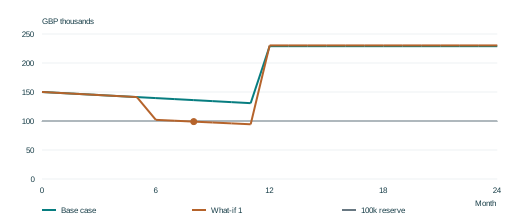
Figure 1. Month-end spendable cash. The marker identifies month 8, the first reserve breach in what-if 1.
The remaining £262,500 loan costs £1,531.25 each month. Cash is £100,468.75 in month 7 and £98,937.50 in month 8. It reaches £94,343.75 in month 11 before the receipt restores liquidity in month 12. The path stays cash-positive and the collateral demand is fully covered, yet the reserve is breached.
3. What if the lending percentage falls to 25% and the receipt is late?
Keep the same 50% portfolio fall in month 6. Tighten the lending percentage further to 25% and move the receipt to month 18. The loan rate stays at 7%. This combines a tighter collateral rule with a longer period before repayment.
| Measure, GBP unless stated | What-if 1 | What-if 2 |
|---|---|---|
| Lending percentage / receipt month | 35% / 12 | 25% / 18 |
| Month-6 debt capacity | 262,500 | 187,500 |
| Collateral repayment required | 37,500 | 112,500 |
| Cash after month-6 repayment | 102,000 | 27,000 |
| Lowest opening/month-end cash | 94,344 | 14,969 |
| First month below reserve | 8 | 6 |
| Interest over 24 months | 19,688 | 23,625 |
The extra pressure comes from the lender assumption, not a larger price fall. At the same £750,000 portfolio value, capacity falls another £75,000. The £112,500 repayment leaves only £27,000 cash in month 6.
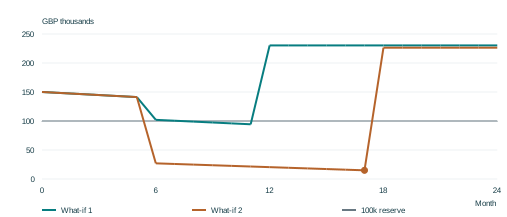
Figure 2. Month-end spendable cash. In what-if 2, cash reaches £14,968.75 in month 17 before the delayed receipt.
The remaining £187,500 debt costs £1,093.75 a month. The collateral demand is fully covered and cash remains positive, but the company operates far below its £100,000 reserve. The receipt in month 18 cannot fund the earlier months. A lower monthly interest bill after forced principal repayment is not evidence of a safer plan.
4. A repayment test and a reserve test are different decisions
| Question | What the case establishes |
|---|---|
| Is the opening loan supported? | Yes: £300,000 is below £750,000 opening capacity. |
| Can the collateral repayment be made? | Yes in both tests. No uncovered collateral demand remains. |
| Is the chosen cash reserve maintained? | No: the first breach is month 8 in test 1 and month 6 in test 2. |
| Does eventual repayment solve the earlier problem? | No. Both loans are repaid by month 24, but the intervening reserve breaches remain. |
Before selecting the loan size, identify the collateral trigger, the cash needed to meet it and the cash required afterwards. Passing the first two tests does not establish that the third is satisfied. Reducing the loan through a partial sale is a separate funding decision explored in LFS-3; it also reduces the investments retained as collateral.
Reproduce the tests in LFS
Enter the common inputs, keep tax off, and inspect Borrow. In Stress tests, set shock month 6, portfolio fall 50% and rate increase 0. For test 1, use lending percentage 35% and receipt delay 0; for test 2, use 25% and delay 6. Select Combined stress, then inspect the monthly cash schedule. The 50%, 35% and 25% trigger table is a separate calculation explained above.
Open Liquidity & Funding Simulator
Method, limits and source
LFS 1.2.0; calculations rechecked on 3 November 2026. One entity and one currency; tax, fees, dividends, cash interest and other monthly flows excluded. Prices stay flat after the one-off shock. Interest is paid before the month-end receipt and collateral cure. Minimum cash means opening or month-end cash, not intramonth liquidity. Tables round to whole GBP; calculations retain full precision.
LFS cures excess debt from available cash, even if that consumes the reserve. It does not simulate forced securities sales, emergency funding or a lender’s contractual notice period. The SEC/FINRA investor alert explains that falling collateral values or changes in eligible collateral can require additional assets or repayment and may lead to liquidation. Its US contractual details are not assumed to apply to this GBP illustration.
SEC/FINRA: Investor Alert - Securities-Backed Lines of Credit (21 Dec 2015)
Illustrative scenario analysis, not a forecast or personalised investment, lending or tax recommendation.
Continue the LFS case-study series
LFS-1: compare selling, borrowing and a combined plan · Includes illustrative tax assumptions.
LFS-2: what happens when a collateral repayment is required? · Before tax.
LFS-3: can a partial sale protect the cash reserve? · Before tax.
LFS-4: can you meet the repayment demand when collateral falls and lending terms tighten? · Before tax.
These cases answer different questions. Their tax and stress assumptions differ; do not compare their figures as if the inputs were identical.