Liquidity & Funding Simulator · LFS-2 · 28 October 2026
Your Portfolio Falls. Then the Lender Wants £90,000 Back.
A £300,000 portfolio-backed loan looks comfortably secured. A severe market fall and tighter lending terms can still push cash below the chosen reserve - before the expected receipt arrives.
The repayment source arrives later. The collateral test happens now.
A fictional company needs to make a £300,000 payment. It owns £1.5 million of investments and has £150,000 cash, of which it wants to preserve £100,000. It borrows the full payment against its portfolio and plans to repay the loan from a separate £400,000 net receipt in month 12.
At the initial 50% lending percentage, the portfolio supports £750,000 of debt. The £300,000 loan therefore begins with £450,000 of collateral headroom. That headroom is not spendable cash, and it does not fix the future lending value of the assets.
| Input | Assumption |
|---|---|
| Payment funded now | £300,000 |
| Opening cash / chosen minimum reserve | £150,000 / £100,000 |
| Opening portfolio / loan | £1.5 million / £300,000 |
| Loan interest / fees | 7% nominal annual, paid monthly / none |
| Lending percentage at the start | 50% of the remaining portfolio value |
| Expected net receipt | £400,000 in month 12 |
| Analysis period | 24 months |
| Growth, distributions and other cash flow | 0%; no dividends, cash interest or other net flows |
| Taxes | Excluded throughout this case |
| Stress timing | Month 6, before the later receipt |
The percentages below are deliberately severe stress assumptions, not quoted lender terms, market forecasts or estimates of how likely these events are. Personal and company resources are not combined.
First establish the base case
With flat prices and unchanged terms, monthly interest is £1,750. The receipt repays the £300,000 principal in month 12. Total interest is £21,000; the lowest opening or month-end cash balance is £130,750 in month 11, above the chosen reserve. Cash at month 24 is £229,000, with £1.5 million of investments retained and no loan outstanding.
That is a funded path under the entered assumptions. It is not a promise that the receipt, portfolio or lender terms will behave this way.
What if 1: the portfolio falls and the lender recognises less of it?
In month 6, impose a 60% portfolio fall: £1.5 million becomes £600,000. Keep the loan rate at 7% so the effect of collateral can be seen separately from a rate increase.
If the lending percentage stays at 50%, the portfolio still supports £300,000. There is no extra repayment under this simple rule, although collateral headroom has fallen to zero.
Now reduce the lending percentage to 35%. The same £600,000 portfolio supports only £210,000. Against £300,000 debt, the model requires £90,000 of additional principal repayment.
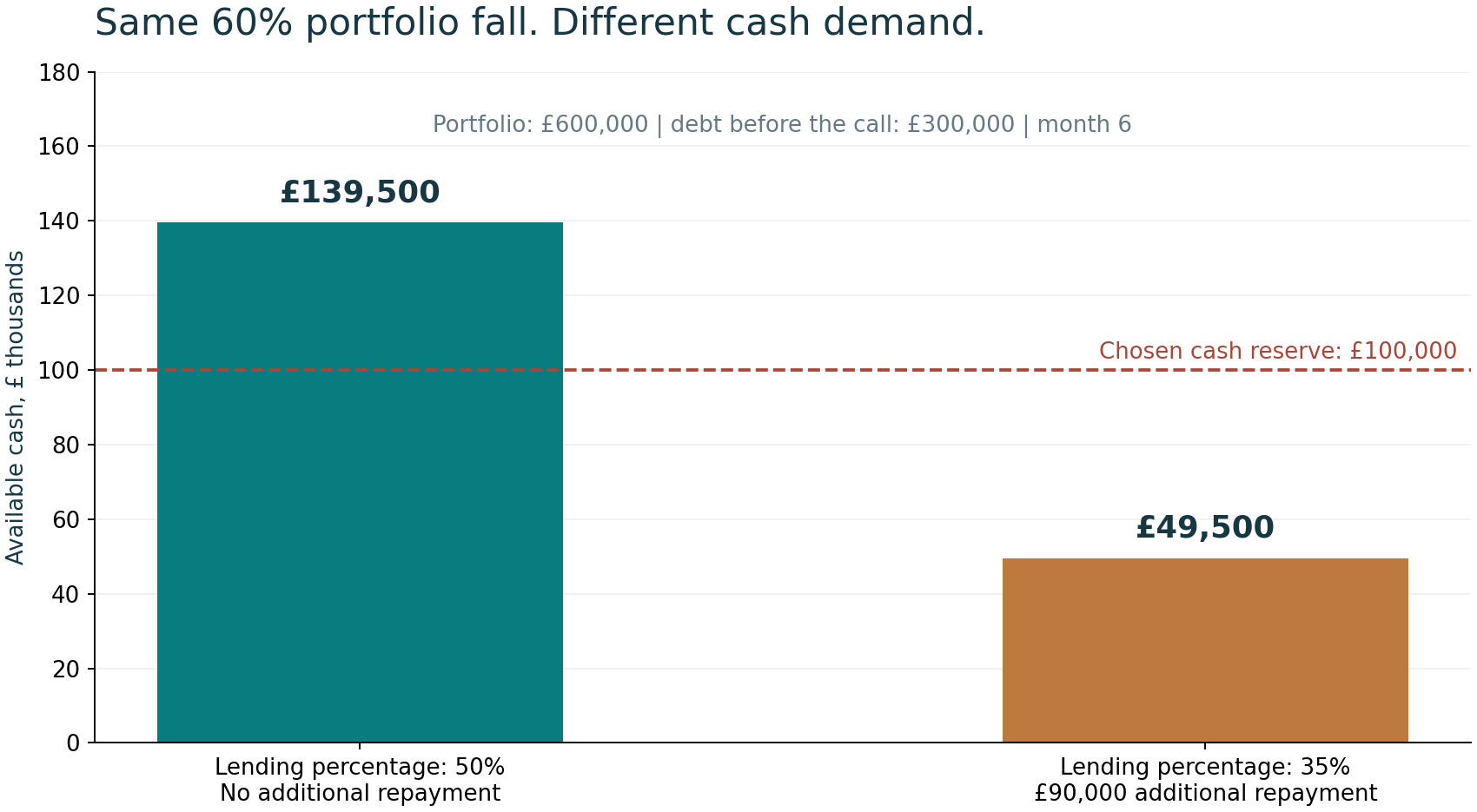
| Month-6 measure | 50% lending percentage | 35% lending percentage |
|---|---|---|
| Portfolio after the 60% fall | £600,000 | £600,000 |
| Supported debt | £300,000 | £210,000 |
| Debt before collateral repayment | £300,000 | £300,000 |
| Additional repayment required | £0 | £90,000 |
| Cash after month-6 interest, before repayment | £139,500 | £139,500 |
| Cash after repayment | £139,500 | £49,500 |
| Debt after repayment | £300,000 | £210,000 |
The £90,000 is not an additional financing expense: it reduces cash and debt by the same amount. But it creates an immediate liquidity problem. The company is left £50,500 below its £100,000 reserve. Cash remains positive, so a reserve breach must not be described as insolvency or a £50,500 unpaid obligation.
This mechanism is not unique to the example. UBS explains that a shortfall in collateral can require additional security or partial/full repayment, and investments may be liquidated if the obligation cannot be met. The actual agreement governs eligibility, deadlines and lender discretion. UBS UK: financing risk considerations.
What if 2: the expected receipt is six months late?
Keep the 60% fall, the 35% lending percentage and the £90,000 month-6 repayment. Move only the £400,000 receipt from month 12 to month 18.
After the collateral repayment, £210,000 debt remains. It costs £1,225 a month to service at 7%. Waiting another six months adds £7,350 of interest and keeps the reserve impaired for longer.
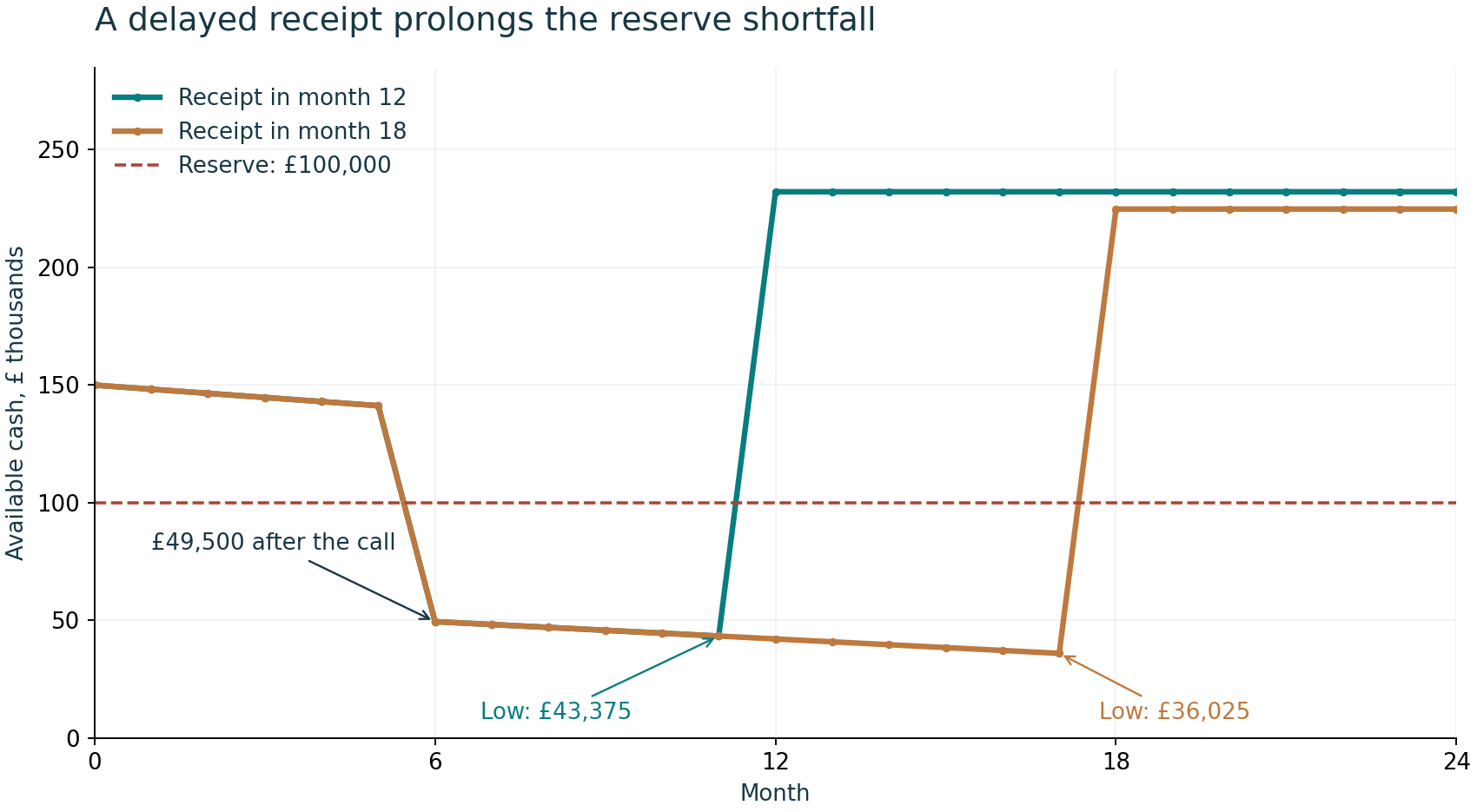
| Outcome after the same month-6 shock | Receipt in month 12 | Receipt in month 18 |
|---|---|---|
| Lowest opening/month-end cash | £43,375, month 11 | £36,025, month 17 |
| First month below £100,000 reserve | 6 | 6 |
| Total interest over the analysis | £17,850 | £25,200 |
| Cash at month 24 | £232,150 | £224,800 |
| Investments retained / debt at month 24 | £600,000 / £0 | £600,000 / £0 |
| Final cash if investments are sold at month 24; tax excluded | £832,150 | £824,800 |
In both paths the demand is covered and cash stays positive. The company nevertheless operates below its chosen reserve until the receipt arrives. The lower interest than on an unchanged £300,000 loan is a consequence of earlier principal repayment; it does not mean that the portfolio shock improved the plan.
When does the cash buffer disappear completely?
The £90,000 demand uses much of the cash, but not all of it. A separate, more severe test makes the distinction clear: impose a 75% portfolio fall in month 6 with the same 35% lending percentage. The portfolio is then worth £375,000 and supports £131,250 debt.
| Month-6 severe test | Amount |
|---|---|
| Repayment demanded: £300,000 − £131,250 | £168,750 |
| Cash available after interest | £139,500 |
| Cash used to repay principal | £139,500 |
| Cash remaining | £0 |
| Uncovered collateral shortfall | £29,250 |
Here the cash buffer is fully exhausted and the demand is still not met. Under the model, month-7 interest creates negative cash. This is an unresolved funding path, not an assumed overdraft. A later receipt cannot make the month-6 demand timely. Forced sales, new borrowing and emergency cash injections are not invented by the model, and its later balances should not be presented as an achievable final outcome.
Which changes address the actual weakness?
The right response depends on the constraint. A partial sale and smaller opening loan can reduce debt exposed to a collateral demand, but leaves fewer investments and may create tax. More opening cash can absorb a demand, but must be genuinely available and not simultaneously allocated elsewhere. Additional eligible collateral depends on the lender accepting it. A different repayment source must arrive early enough to meet the relevant demand.
Before choosing, ask: what value does the lender recognise after a fall; what repayment would be required; which cash can meet it without using the reserve; and what happens if the expected receipt is late? Loan interest alone does not answer these questions.
The decision is not whether the portfolio is valuable on paper. It is whether the plan can meet a cash demand when the lender makes it.
Reproduce the case in LFS
Open the Liquidity & Funding Simulator. Use the assumptions above, switch tax off, set annual capital growth and the stress-rate increase to 0, portfolio fall to 60%, stressed lending percentage to 35%, and the shock to month 6. Select Borrow and Combined stress. Start with receipt month 12 and delay 0; change delay to 6 for the second test. The 75% fall is a separate severity test.
Download the main case, the delayed case or the severe case. Use “Load saved case” in LFS, then select “Combined stress”.
Scope, accounting and sources
This deterministic, single-entity, single-currency illustration uses LFS 1.2.0. Interest is paid monthly before the month-end receipt; a shock affects the month-6 collateral calculation. Cash cures reduce principal even if they consume the chosen reserve. The snapshot immediately before the cure is after the current month’s interest. Lowest cash means opening or month-end cash, not intramonth liquidity.
Tax is excluded in every scenario, so final cash is before tax. No investment return, dividends, cash yield, fees, transaction costs, FX, interest-rate increase or price recovery is assumed. The asset or benefit acquired with the common £300,000 payment is excluded equally. The closing sale is only an end-point comparison. Actual facilities can have different advance rates, daily valuation, cure periods, demand clauses and asset-sale rights.
Sources checked 28 October 2026: UBS UK financing solutions; SEC/FINRA investor alert on securities-backed credit. The latter describes US facilities; its specific deadlines are not assumed to apply to this UK-style example. This case is scenario analysis, not personalised investment, credit or tax advice.
Continue the LFS case-study series
LFS-1: compare selling, borrowing and a combined plan · Includes illustrative tax assumptions.
LFS-2: what happens when a collateral repayment is required? · Before tax.
LFS-3: can a partial sale protect the cash reserve? · Before tax.
LFS-4: can you meet the repayment demand when collateral falls and lending terms tighten? · Before tax.
These cases answer different questions. Their tax and stress assumptions differ; do not compare their figures as if the inputs were identical.