CDL · PRACTICAL CASE STUDIES · ILLUSTRATIVE EXAMPLE
Financing Simulator · FS-2
FS-2 | The main tenant leaves: which loan structure protects the cash buffer?
Financing Simulator · One warehouse, two loan structures and two what-if scenarios.
A company owns a rented warehouse and is choosing how to refinance €1.8 million of existing debt. It has two offers with the same 5.5% fixed rate and 10-year final maturity. Structure A starts repaying principal immediately. Structure B pays interest only in year one, then amortises the principal over the remaining nine years.
The owner has €120,000 of free cash after refinancing and wants to preserve at least €60,000. Its main tenant accounts for 60% of rent. Before choosing a loan, the company asks: what happens to cash if that tenant leaves in June and the space needs a refit for a new occupier?
The property and the initial disruption
| Assumption | Value |
|---|---|
| Collected rent at full occupancy | €30,000 a month |
| Owner-paid operating costs | €5,000 a month + 5% of collected rent |
| Transfer to repair reserve | €1,000 a month; reserve starts at zero |
| Main tenant leaves | June; collected rent falls to €12,000 a month |
| Refit for the replacement tenant | €90,000 paid in June |
| Full rent resumes | September: an assumption, not a prediction |
| Opening free cash / planning minimum | €120,000 / €60,000 |
At full occupancy, operating costs leave €23,500 a month. After the €1,000 repair-reserve transfer, €22,500 is available for the loan. During the vacancy, that flow falls to €5,400 before the one-off refit.
By June, the repair reserve has accumulated €6,000, including that month’s transfer. It pays that part of the refit; the remaining €84,000 comes from free cash. June’s pre-loan cash flow is therefore €5,400 - €84,000 = -€78,600. The refit is not counted twice.
1. Base case: full rent resumes in September
Use identical property cash flows for both loans. Both have monthly payments, zero fees and no final balloon. The new loan replaces existing debt; it does not add €1.8 million to opening free cash.
| Measure | A: no grace | B: 12-month principal grace |
|---|---|---|
| Monthly payment in year one | €19,535 | €8,250 |
| Lowest month-end free cash | €8,422 | €98,700 |
| First month below €60,000 | 6 | None |
| First month below zero | None | None |
| Year-end free cash | €20,283 | €155,700 |
| Debt outstanding after year one | €1,661,117 | €1,800,000 |
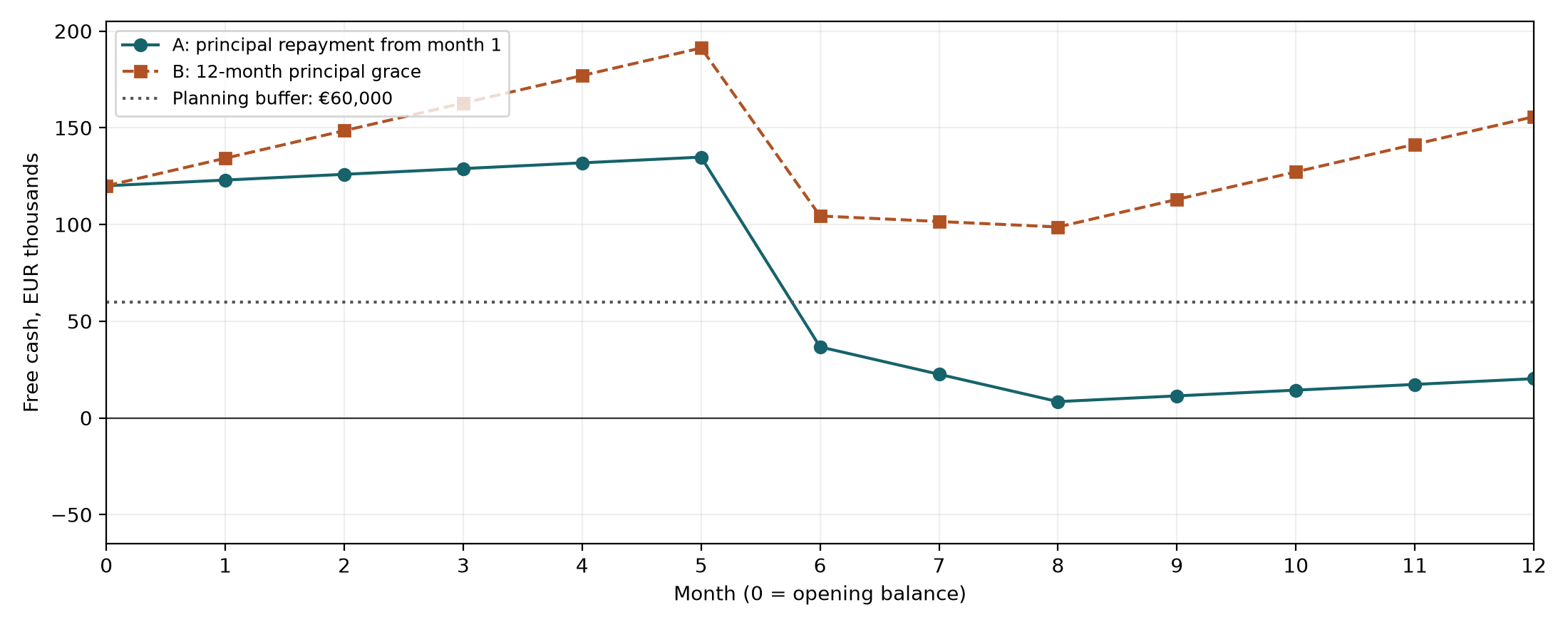
B preserves the chosen buffer; A breaches it in June. The lowest balances occur in August: €8,422 under A and €98,700 under B. The €90,278 difference comes from deferred principal, not better property performance.
A remains cash-positive at every modelled month-end, but leaves too little protection against the owner’s objective. At year-end, B retains €135,417 more free cash and €138,883 more outstanding principal. The €60,000 buffer is an internal planning threshold, not a contractual bank covenant. Tables are rounded to the nearest euro.
2. What if full rent resumes in December?
Keep the refit at €90,000, but extend reduced rent from June-August to June-November. Full monthly receipts of €30,000 resume in December. Every other assumption stays unchanged.
| Measure | A: no grace | B: 12-month principal grace |
|---|---|---|
| Lowest month-end free cash | -€33,982 | €90,150 |
| First month below €60,000 | 6 | None |
| First month below zero | 9 | None |
| Year-end free cash | -€31,017 | €104,400 |
| Change in year-end cash versus base | -€51,300 | -€51,300 |
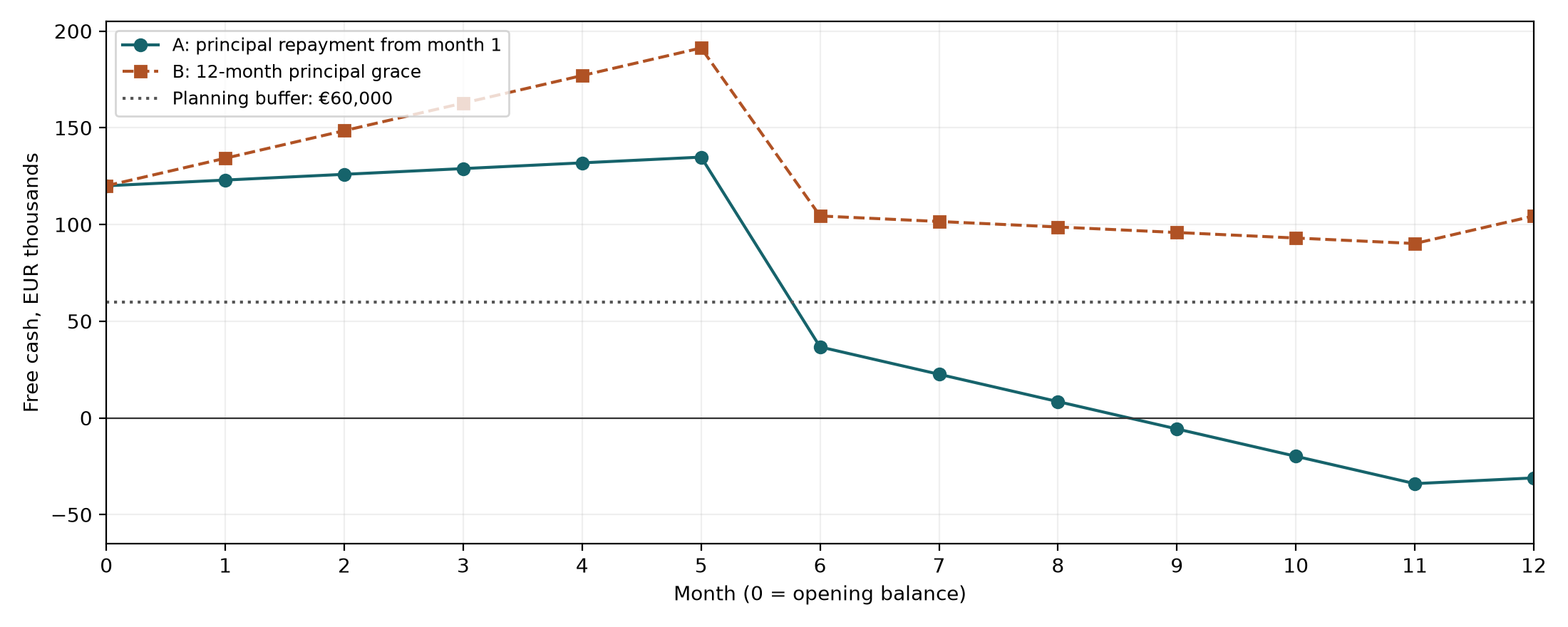
Three more months of reduced rent turn A’s thin buffer into a cash shortfall. Each extra month removes €17,100: the difference between €22,500 and €5,400. The combined impact is €51,300 under either structure.
A turns negative in September and reaches -€33,982 in November. Preserving the €60,000 minimum would require €93,982 of additional opening funding, assuming it carries no financing cost.
B remains above the buffer, with a low of €90,150 in November. That protection depends on rent recovering before principal grace ends. From month 13, the payment rises to €21,168. If reduced rent continued then, monthly cash would fall by approximately €15,768.
3. What if the refit costs €150,000?
Restore full rent in September, as in the base case. Change only the refit: €150,000 instead of €90,000, paid in June. After using €6,000 from the repair reserve, €144,000 must come from free cash. June’s pre-loan cash flow becomes -€138,600.
| Measure | A: no grace | B: 12-month principal grace |
|---|---|---|
| Lowest month-end free cash | -€51,578 | €38,700 |
| First month below €60,000 | 6 | 6 |
| First month below zero | 6 | None |
| Year-end free cash | -€39,717 | €95,700 |
| Change in year-end cash versus base | -€60,000 | -€60,000 |
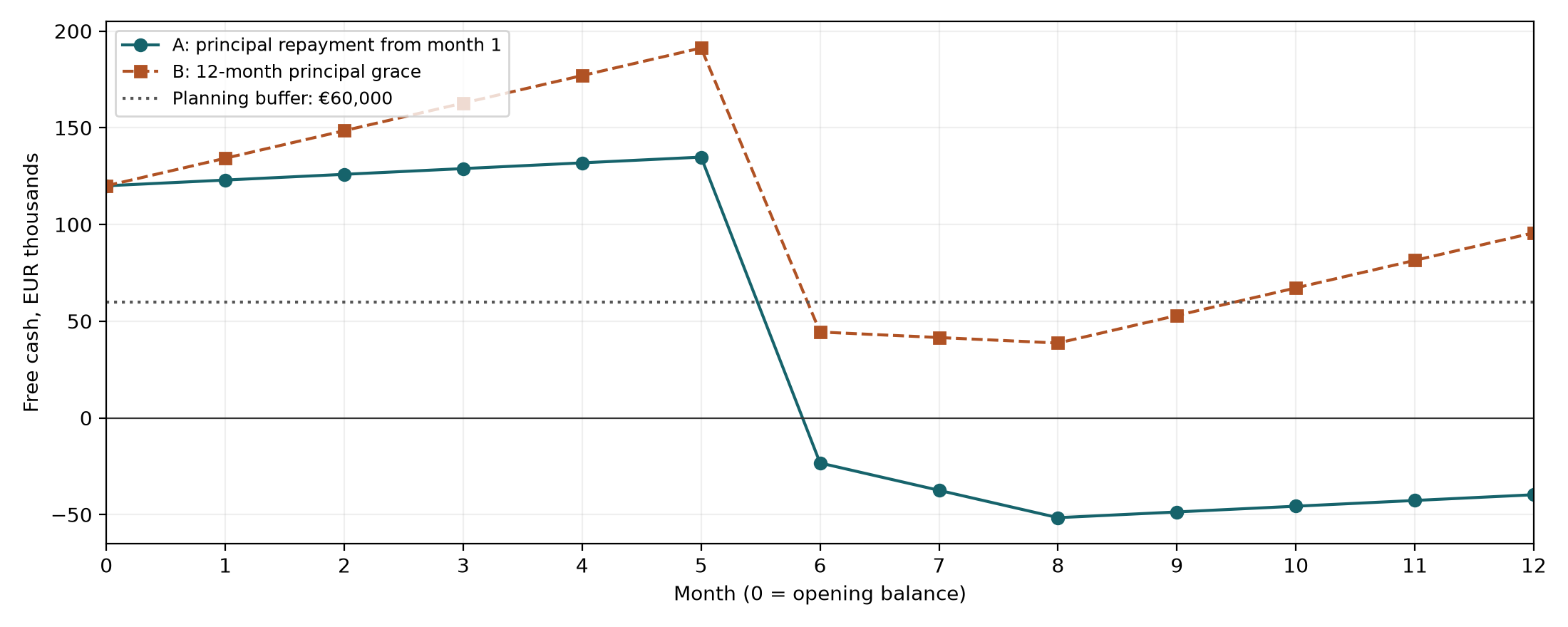
Principal grace no longer preserves the chosen buffer. B stays cash-positive but reaches just €38,700 in August: €21,300 below the objective. A turns negative in June and reaches -€51,578 in August.
With all other assumptions unchanged, B can absorb a refit of up to €128,700 without dropping below €60,000 at month-end. That is the €90,000 base refit plus the €38,700 margin above the minimum buffer. A higher cost requires additional funds, a different refit payment schedule or a revised loan arrangement.
This threshold holds only if full rent returns in September. The two what-if cases are separate tests. A delayed recovery and a higher refit cost occurring together would consume more cash; the individual results are not two independent layers of protection.
What does the cash protection cost?
| Measure | A: no grace | B: 12-month principal grace |
|---|---|---|
| Monthly payment from month 13 | €19,535 | €21,168 |
| Normal €22,500 cash flow left after payment | €2,965 | €1,332 |
| Total interest over 10 years | €544,168 | €585,143 |
B buys time, but after year one it leaves only about €1,332 of monthly cash at normal rent. Its payment is approximately €1,633 higher and full-term interest approximately €40,976 greater. Those figures assume the original schedules run to maturity without early repayment or refinancing.
The conclusion is conditional: B provides better first-year protection against the tenant departure and delayed re-letting tested here. The larger refit exposes its limit. A loan choice needs both enough cash for the transition and a defensible forecast for the higher payments that follow.
Reproduce the comparison in FS
Enter €1.8 million, a 120-month term, 5.5% fixed interest, monthly annuity payments, zero fees and no balloon. Set principal grace to zero months for A and 12 for B. Compare 12 months, starting with €120,000 of free cash and a €60,000 minimum buffer.
| Scenario | Cash flow before these loan payments |
|---|---|
| Base | Months 1-5 and 9-12: €22,500; month 6: -€78,600; months 7-8: €5,400. |
| Full rent from December | As base, but months 9-11: €5,400. |
| €150,000 refit | As base, but month 6: -€138,600. |
The cash flows already include vacancy, repair-reserve transfers and the refit. Do not apply those effects again through separate stress controls. Treat the borrowing as refinancing so that repaying the old debt prevents new proceeds from increasing opening free cash. Open CDL Financing Simulator. See the product page for current access terms.
Method and limitations
Illustrative case, not an actual transaction, market valuation or bank offer. No tax, sale, revaluation, additional financing or interest on free cash is included. Monthly interest is 5.5% divided by 12. Negative balances are not automatically funded. Checks occur at month-end and do not guarantee liquidity on every day. The repair reserve is separate; after the June refit it resumes accumulating €1,000 a month.
Liquidity is tested over the first year; full loan schedules are used to compare later payments and total interest. A real transaction requires checking leases, re-letting time, tenant incentives, the refit budget and bank terms. Calculated with the available local FS model and independently verified. Prepared with AI assistance. Corporate Debt Lab provides the simulator.