CDL · PRACTICAL CASE STUDIES · ILLUSTRATIVE EXAMPLE
Financing Simulator · FS-1
FS-1 | Choosing a €500,000 loan: lower interest or a stronger cash buffer?
Financing Simulator · Three offers, three cash-flow assumptions and one €50,000 reserve.
A company needs to refinance a €500,000 loan. The new borrowing will repay the old principal in full, so the transaction adds no cash to the business. The company has €100,000 of available cash before fees and expects €13,000 a month after operating costs, cash tax and investment, but before the new loan payments. There are no other debt payments in this example.
The finance team has three fixed-rate offers. It wants to preserve at least €50,000 of cash while keeping financing costs under control. Which offer fits that objective over the next 36 months?
1. Base case: €13,000 a month
| Measure | Offer A | Offer B | Offer C |
|---|---|---|---|
| Fixed annual rate | 5% | 6% | 7% |
| Term, months | 36 | 60 | 60 |
| Upfront cash fee | €5,000 (1%) | €10,000 (2%) | €0 |
| Monthly payment | €14,985 | €9,666 | €9,901 |
| Cash after fee, month 0 | €95,000 | €90,000 | €100,000 |
| Cash at month 36 | €23,524 | €210,010 | €211,578 |
| Debt still owed at month 36 | €0 | €218,102 | €221,131 |
| First month below €50,000 | 23 | None | None |
| Interest + fees, full loan term* | €44,476 | €89,984 | €94,036 |
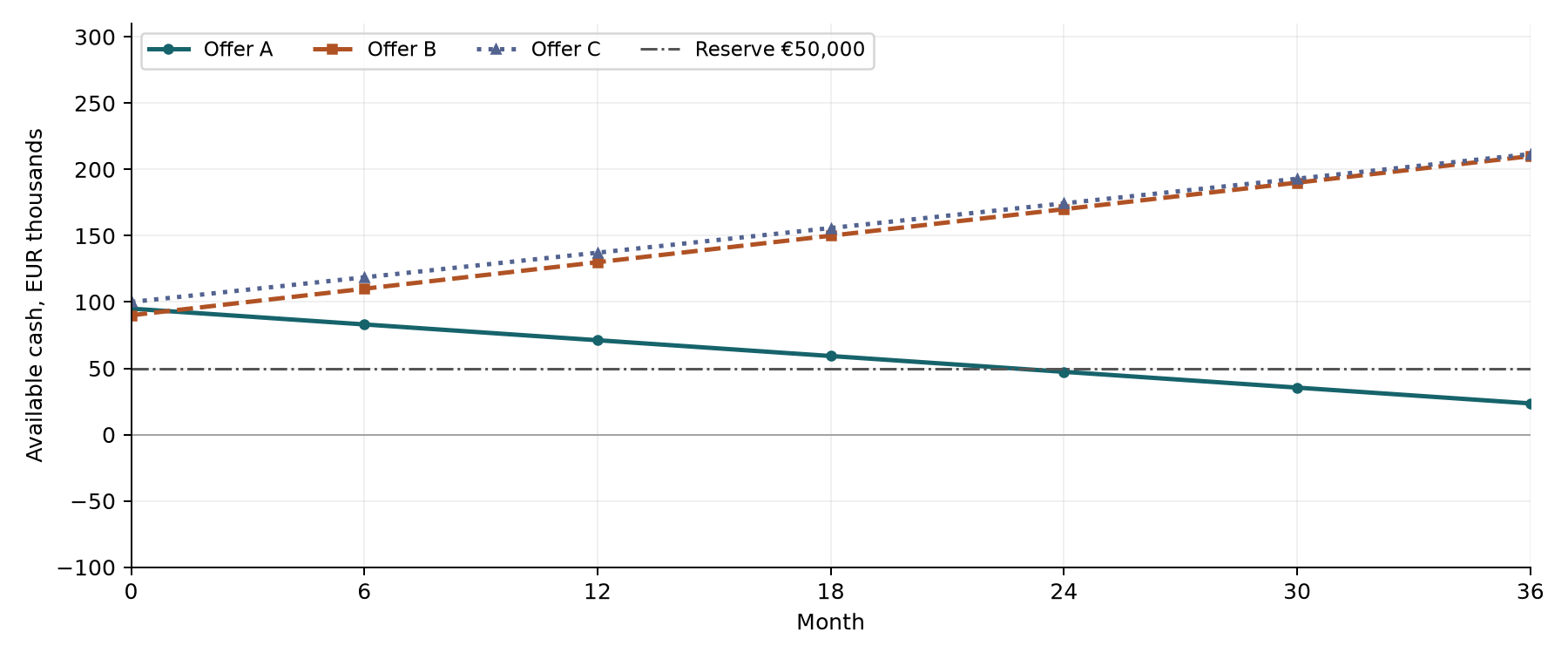
A is cheapest, but its repayment schedule does not fit the base cash forecast. Its €14,985 monthly payment exceeds available monthly cash generation by €1,985. The buffer falls below €50,000 in month 23 and finishes at €23,524.
B and C preserve more cash by repaying principal more slowly. They still owe €218,102 and €221,131 at month 36. Those obligations belong beside the cash balances; the retained cash is not a free saving.
C ends month 36 with €1,569 more cash than B because it avoids B’s €10,000 fee. However, C owes €3,029 more and has the higher full-term cost. B’s cumulative cash-payment advantage overtakes the fee difference in month 43, assuming both loans continue unchanged. The comparison horizon matters.
2. What if monthly cash falls to €10,000?
Change only monthly cash generation: €10,000 instead of €13,000 from month 1. Rates, fees, opening cash and repayment terms stay unchanged. This is a €3,000 monthly reduction, or approximately 23.08%, not a 20% stress.
| Measure | Offer A | Offer B | Offer C |
|---|---|---|---|
| Monthly cash after debt payment | −€4,985 | €334 | €99 |
| Cash at month 36 | −€84,476 | €102,010 | €103,578 |
| Lowest cash, including month 0 | −€84,476 | €90,000 | €100,000 |
| First month below reserve | 10 | None | None |
| Extra cash to preserve reserve** | €134,476 | €0 | €0 |
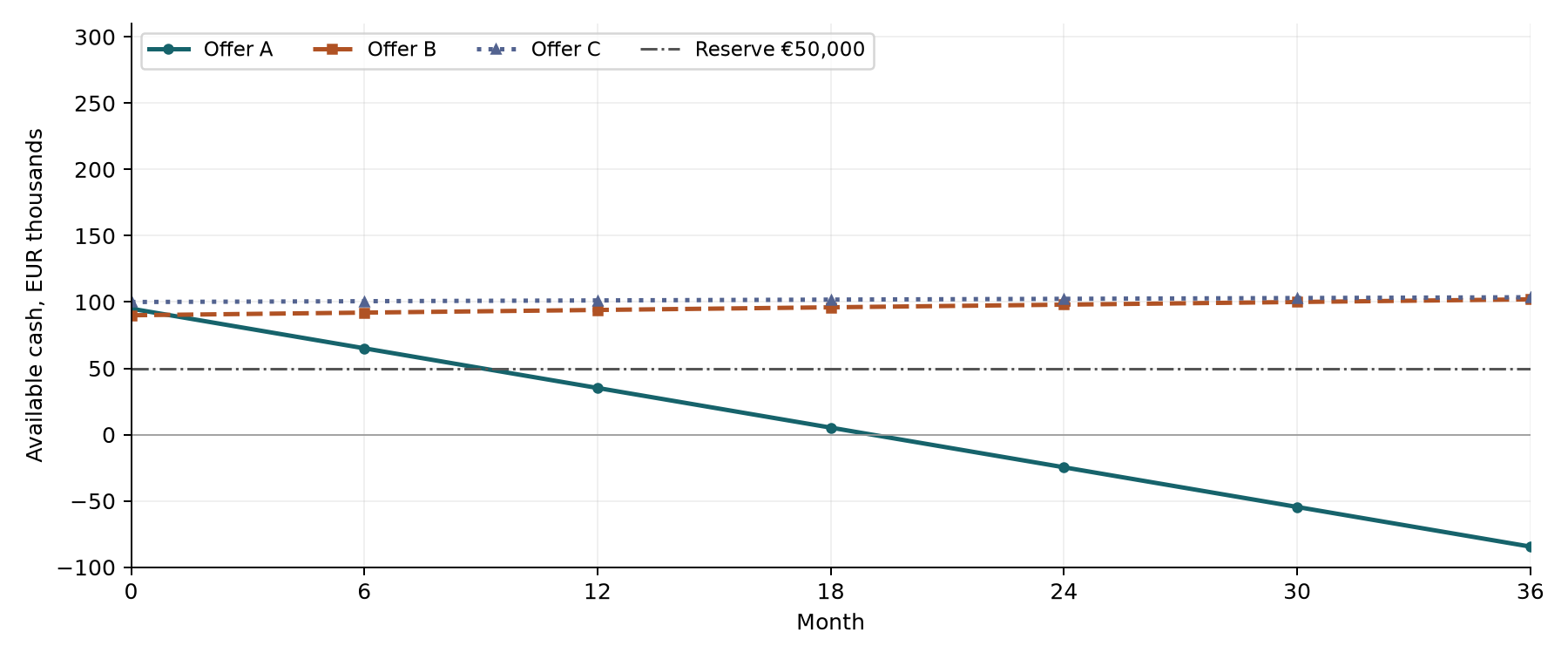
A now needs action before month 10. It breaches the reserve then and becomes cash-negative in month 20. Keeping the €50,000 reserve throughout the test would require €134,476 of additional opening cash, assuming that money has no financing cost. This is a funding requirement, not an assumed facility.
B and C remain above the reserve, but generate only €334 and €99 a month after the loan payment. They pass this particular test because they retain their opening buffers, not because they can absorb unlimited disruption. An unmodelled payment could still change the result.
3. What if monthly cash reaches €15,000?
Now change monthly cash generation to €15,000 from month 1. Keep every other input unchanged. This tests when the lowest-rate offer becomes a viable choice.
| Measure | Offer A | Offer B | Offer C |
|---|---|---|---|
| Monthly cash after debt payment | €15 | €5,334 | €5,099 |
| Cash at month 36 | €95,524 | €282,010 | €283,578 |
| Lowest cash, including month 0 | €95,000 | €90,000 | €100,000 |
| First month below reserve | None | None | None |
| Extra cash to preserve reserve** | €0 | €0 | €0 |
A now preserves the reserve and clears the debt in month 36. It produces only about €15 of monthly cash after debt service, but the €95,000 starting balance remains intact. Its full-term interest and fees are €45,508 below B’s. For a team prioritising debt repayment and total cash cost, A deserves reconsideration—provided the stronger forecast is credible.
Under these flat-flow assumptions, A needs approximately €13,735.45 a month to preserve a €50,000 reserve through month 36. This follows from €14,985.45 − (€95,000 − €50,000) / 36. The threshold uses the opening buffer; it does not mean the loan pays for itself each month. Seasonal cash troughs require a separate monthly test.
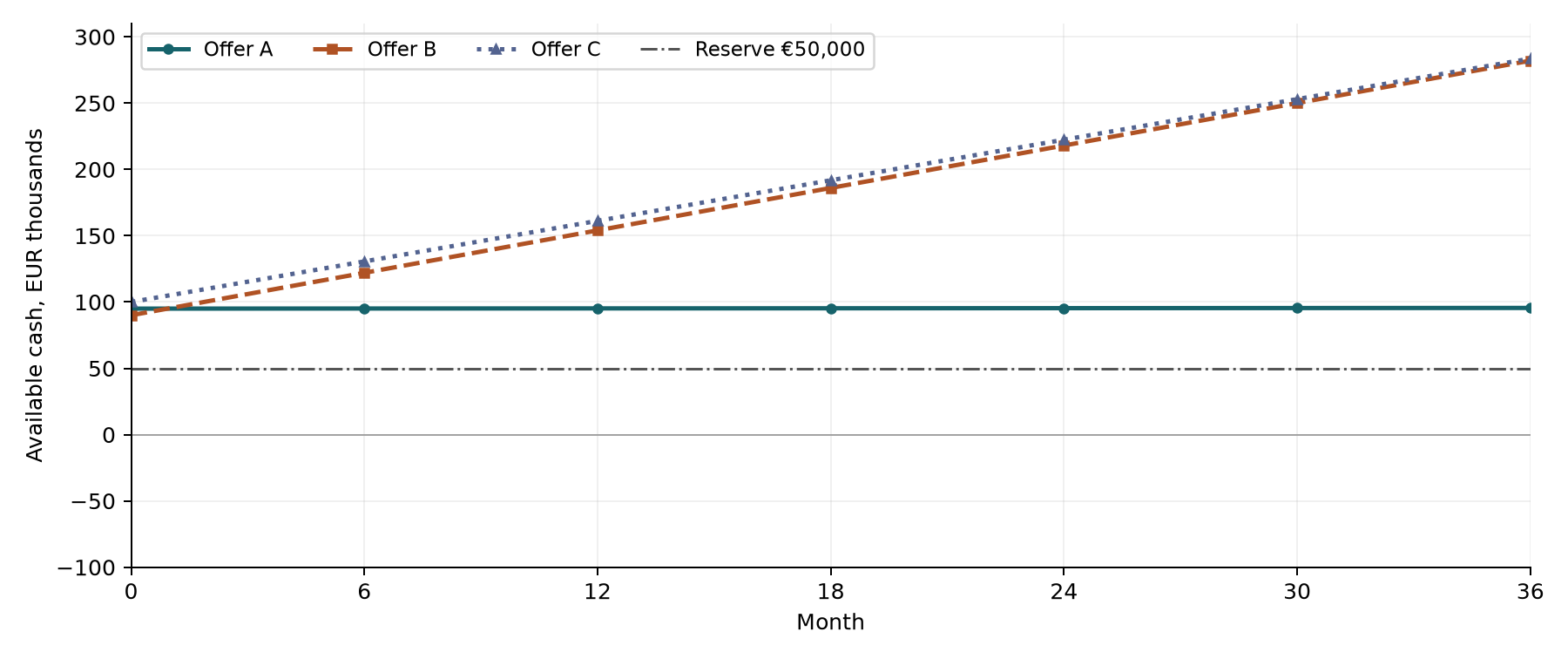
The decision changes with the cash forecast. At €13,000, A is cheapest but breaches the reserve. At €10,000, B and C retain their buffers but leave little recurring headroom. At €15,000, A passes the reserve test and eliminates the debt sooner. Choose the cash assumptions you can defend before choosing the loan.
Reproduce the comparison in FS
In Financing Simulator, set €500,000, EUR, a 36-month comparison and the three offers in Table 1. Use monthly annuity payments, upfront cash fees of 1%, 2% and 0%, and zero grace, balloon, recurring fees and exit costs. Set opening cash to €100,000, minimum reserve to €50,000 and other debt payments to zero.
Treat the new loan as refinancing: its proceeds repay the old principal and do not increase opening available cash. Run the cash-flow test separately at €13,000, €10,000 and €15,000 per month. Set the stress controls to zero (rate increase, cash-flow reduction, extra outflow and delayed receipt) so the scenario is not applied twice. These article inputs differ from the simulator’s default example.
Open CDL Financing Simulator. See the product page for current access terms.
Illustrative case, not a client result or a lending recommendation. Monthly interest is the fixed annual rate divided by 12; payments are at month-end. The reserve is an internal planning threshold, not a covenant. Cash forecasts are supplied assumptions, not independently verified by FS. Negative balances continue the arithmetic without assuming rescue funding. Taxes and investment are already reflected in the input cash flow; no separate tax shield, discounting, FX, intra-month liquidity or contractual covenant calculation is included. * Full-term costs cover different maturities and are not an effective annual rate or an NPV ranking. ** Extra opening cash = max(0, reserve − lowest projected cash). Figures use unrounded calculations and are displayed to the nearest euro. Prepared with AI assistance; numbers checked against the captured FS engine and an independent amortisation calculation. Corporate Debt Lab provides the simulator.