CDL · PRACTICAL CASE STUDIES · ILLUSTRATIVE EXAMPLE
M&A Cash-Flow Simulator · MAS-1
MAS-1 | A £12 million acquisition: will cash cover the deferred seller payment?
M&A Cash-Flow Simulator · One acquisition, a base case and two what-if scenarios.
A buyer is negotiating the acquisition of a company for £12 million in total. Of that price, £9 million is payable at closing and £3 million at the end of year three. The deferred amount is a fixed obligation to the seller, not an earn-out linked to future performance.
To fund the initial payment and related requirements, the buyer arranges a £4.2 million bank loan and £6 million of equity. After closing, £300,000 remains in cash. Before signing, the buyer needs to answer a different question: can the acquired business service the bank and accumulate enough cash to pay the seller? Having enough money to complete the purchase does not answer that question.
What is funded at closing?
| Sources and uses at closing | Amount |
|---|---|
| Payment to seller | £9,000,000 |
| Fees, integration and initial working capital | £900,000 |
| Cash retained in the business | £300,000 |
| Total initial funding required | £10,200,000 |
| Bank loan + equity | £4,200,000 + £6,000,000 |
The additional £3 million seller payment is outside the £10.2 million initial funding requirement: it falls due later. The bank loan runs for seven years at 8% annual interest, with equal annual principal repayments of £600,000 and interest on the opening balance.
What do we expect the business to generate?
First-year revenue is £12 million. The contribution margin is 45%: the share left after variable costs. After £3.4 million of fixed operating costs, EBITDA is £2 million. This is earnings before interest, tax, depreciation and amortisation, not cash available for payments.
Revenue grows by 3% a year. Fixed costs, depreciation and capital expenditure grow by 2%. Initial annual depreciation is £300,000 and capital expenditure £400,000. The model applies 20% tax to positive earnings after depreciation and bank interest. From year two, additional working capital is 10% of positive revenue growth; the initial requirement is already funded at closing.
1. Base case: the bank is covered, but the seller is not
Start with EBITDA and deduct cash tax, capital expenditure and additional working capital. From that cash flow, pay bank principal and interest, followed by the seller obligation.
| Year | Cash before payments | Bank principal + interest | Seller payment | Closing cash |
|---|---|---|---|---|
| 1 | £1,327,200 | £936,000 | £0 | £691,200 |
| 2 | £1,350,000 | £888,000 | £0 | £1,153,200 |
| 3 | £1,410,384 | £840,000 | £3,000,000 | -£1,276,416 |
| 4 | £1,473,492 | £792,000 | £0 | -£594,924 |
| 5 | £1,539,417 | £744,000 | £0 | £200,493 |
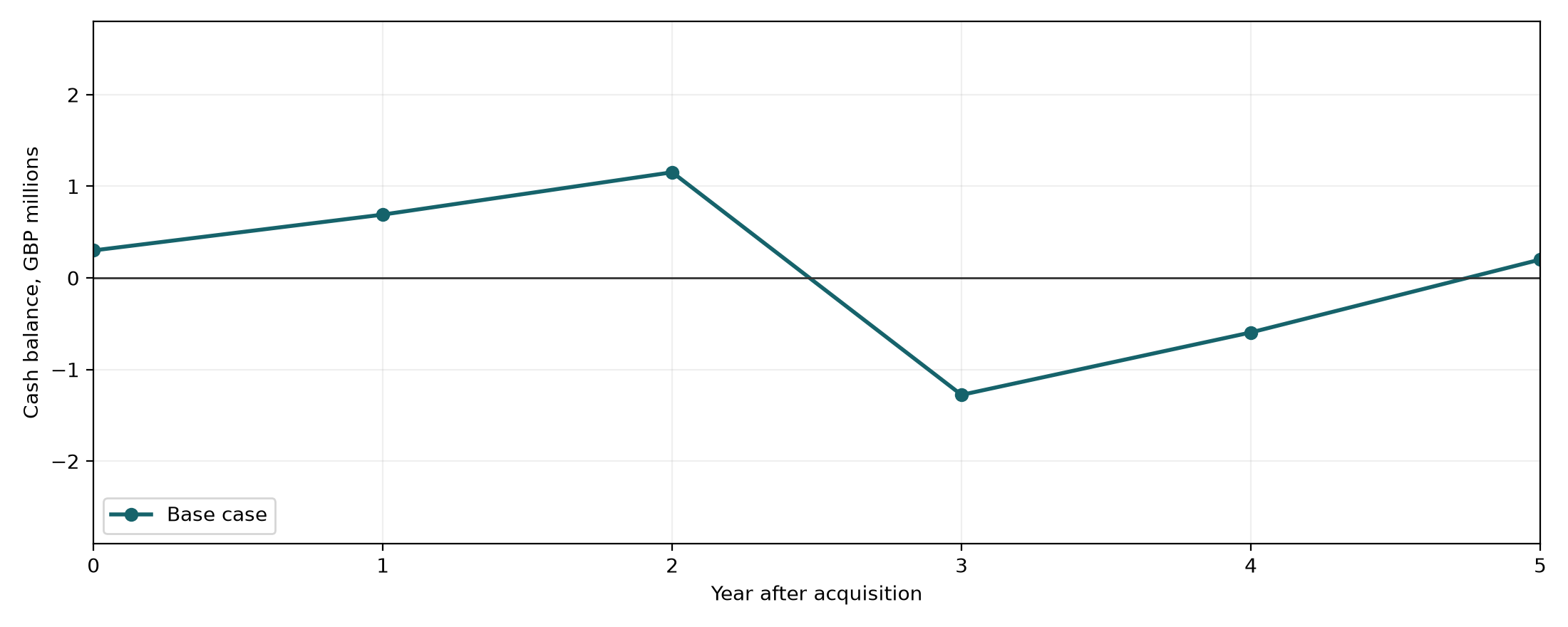
The funding gap appears in year three. Cash accumulated by then is £1,153,200. The business generates £1,410,384 before payments during the year and pays £840,000 to the bank. That leaves £1,723,584 for a £3 million seller obligation: a £1,276,416 unfunded gap.
Minimum bank debt-service coverage is 1.42 times, above the selected 1.20 planning threshold. But this ratio compares cash flow with bank payments only; it excludes the seller. A table of all payments therefore tells a different story from the bank ratio alone.
The positive £200,493 balance in year five does not resolve the year-three gap. The chart continues the arithmetic without assuming rescue funding. A real financing solution would change later cash flows. Bank debt still outstanding after year five is £1.2 million.
2. What if revenue is 10% lower?
Reduce revenue by 10% in every forecast year. Keep 3% annual growth, fixed costs and deal terms unchanged. Variable costs follow revenue at the same 45% contribution margin; tax and additional working capital are recalculated.
| Measure | Base case | Revenue 10% lower |
|---|---|---|
| Year-one EBITDA | £2,000,000 | £1,460,000 |
| Year-one cash before payments | £1,327,200 | £895,200 |
| Year-one bank payments | £936,000 | £936,000 |
| Minimum bank coverage | 1.42x | 0.96x |
| First negative closing-cash year | 3 | 3 |
| Year-three funding gap to zero | £1,276,416 | £2,604,377 |
| Year-five closing cash | £200,493 | -£2,077,992 |
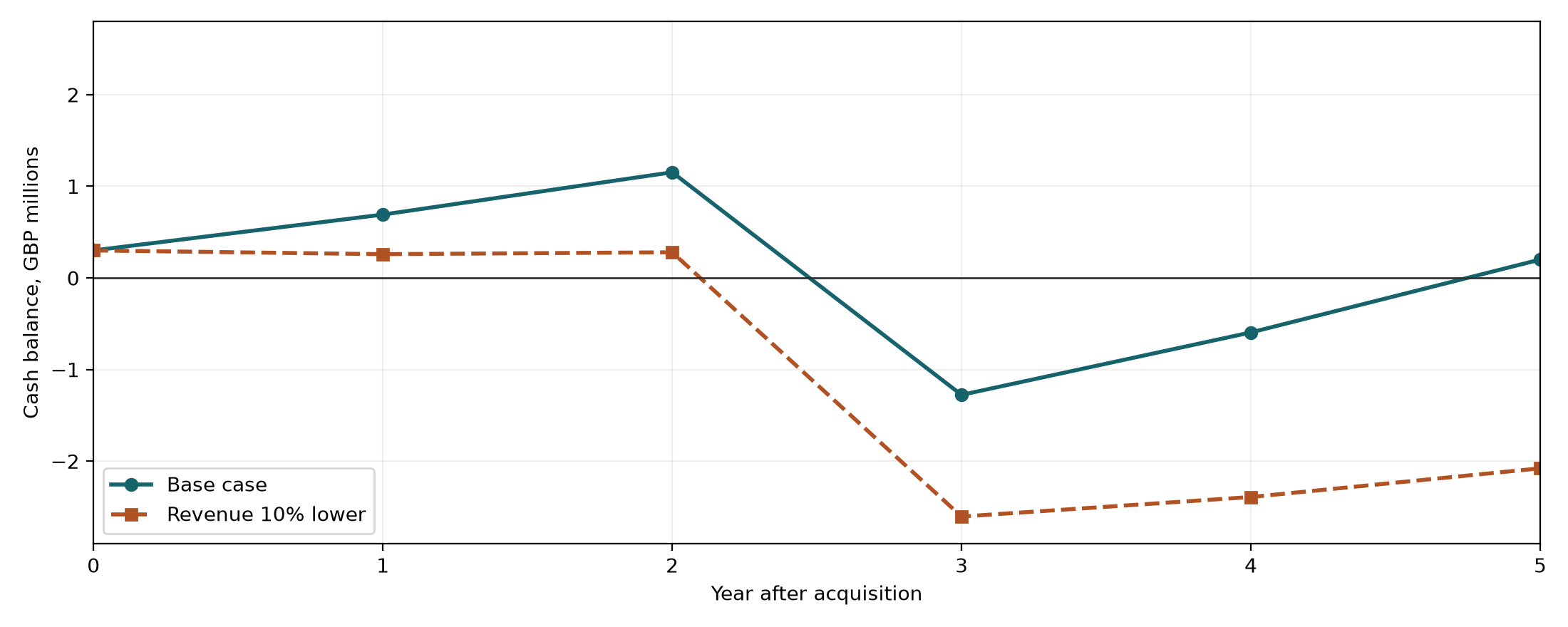
Positive EBITDA no longer covers even the full bank payment in year one. Cash of £895,200 falls £40,800 short of the £936,000 principal and interest payment. Opening cash covers that difference, but this is not a sustainable solution to the future seller payment.
The year-three gap increases by £1,327,961. The first negative year is unchanged, but the funding need more than doubles. Identifying when cash runs out is not enough; the amount matters too.
Avoiding negative annual closing balances in this scenario would require another £2,604,377 of opening cash, assuming that funding has no cost. This reaches zero, not a separate minimum reserve. The £300,000 input is opening cash, not a mandatory cash floor.
3. What if the seller receives £3 million in year five?
Restore base-case revenue. Change only the fixed seller payment date from year three to year five. The initial price, bank loan and £6 million equity contribution stay unchanged. To isolate timing, assume no additional interest or compensation to the seller.
| Measure | Seller paid in year 3 | Seller paid in year 5 |
|---|---|---|
| Initial equity | £6,000,000 | £6,000,000 |
| Year-three closing cash | -£1,276,416 | £1,723,584 |
| Lowest cash, including opening balance | -£1,276,416 | £200,493 |
| First negative closing-cash year | 3 | None in the model |
| Year-five closing cash | £200,493 | £200,493 |
| Bank debt after year five | £1,200,000 | £1,200,000 |
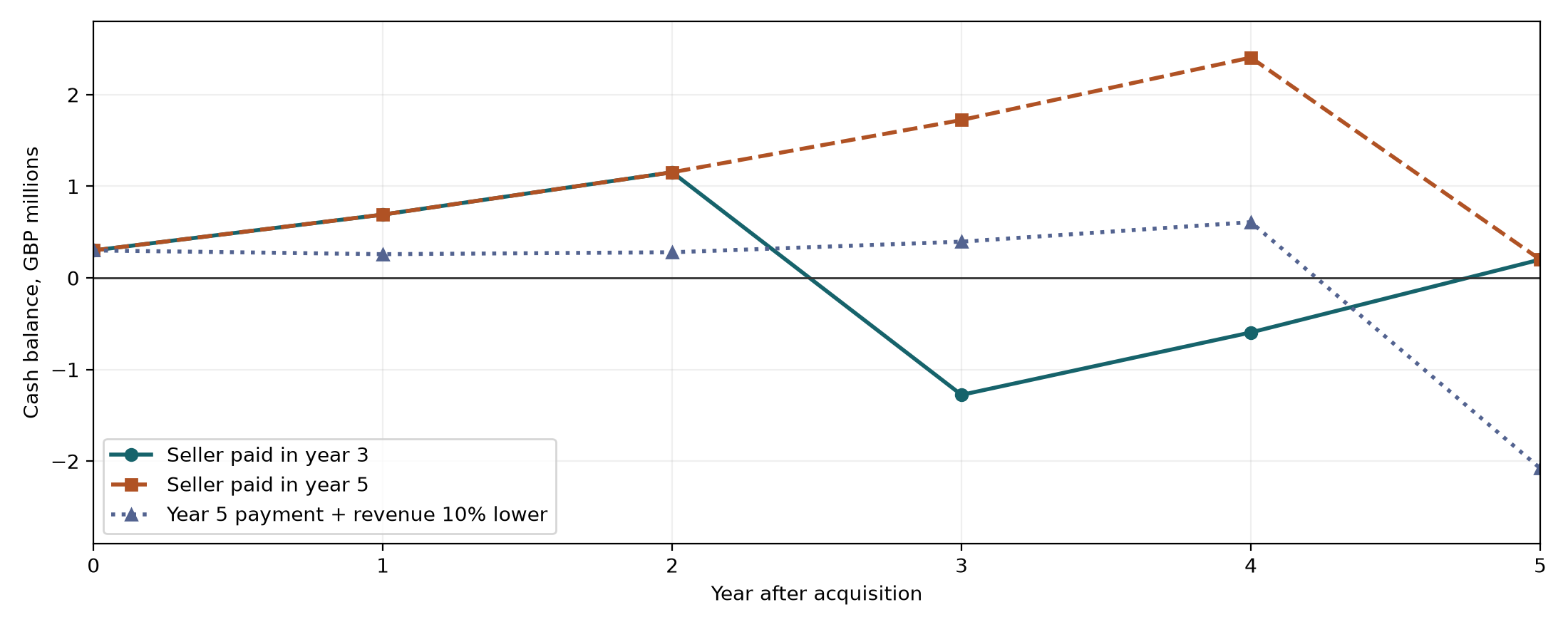
At base-case revenue, the extension removes negative annual closing balances. By the end of year five, £3,200,493 has accumulated before paying the seller. After payment, £200,493 remains. The ending balance is unchanged because only timing has changed, not the amount or operating result.
This is a negotiating proposal, not a unilateral choice. The seller may require interest, a higher price or security. The model does not value those contract changes or calculate the present value of the extension.
Cross-check the proposed solution: combine the year-five payment with 10% lower revenue, and the gap moves to year five rather than disappearing. It is £2,077,992. The dotted line shows this combination. A later deadline buys time; it does not replace sufficient operating cash flow.
What should the buyer decide?
The acquisition can be funded at closing, but the original terms leave a £1.28 million year-three gap. A later seller payment works at base-case revenue, yet fails under the 10% downside. The next discussion should combine payment timing, defensible revenue assumptions and explicitly arranged additional capital or financing.
Before signing, the buyer should substantiate revenue and margin, test investment and working-capital requirements, and negotiate a workable payment schedule. Forecast earnings and initial purchase funding are only the starting point.
Reproduce the comparisons in MAS
Use the GBP example in M&A Cash-Flow Simulator as a starting point and copy the assumptions into your case. The article uses £9 million payable at closing, £3 million deferred, a £4.2 million bank loan at 8% for seven years, and £300,000 opening cash.
| Run | What to change |
|---|---|
| Base case | No revenue reduction; seller paid in year 3. |
| What-if 1 | Select revenue -10%; keep seller payment in year 3. |
| What-if 2 | Restore base revenue; move seller payment to year 5. |
| Combined check | With payment in year 5, also apply revenue -10%. |
Do not reduce initial revenue manually and also apply the same -10% stress: that would apply the downside twice. Compare cash balances, bank coverage and remaining debt, not EBITDA alone. Open CDL M&A Cash-Flow Simulator. See the product page for current access terms.
Method and limitations
Illustrative case, not an actual acquisition or investment recommendation. The example assumes a common cash framework for operating and transaction payments. A real deal requires checks on cash-transfer rights between the target, buyer and borrower, contractual restrictions and tax effects.
The model is annual, with bank and seller payments at year-end; it does not establish liquidity within the year. Bank coverage is cash after tax, capital expenditure and additional working capital divided by bank principal and interest. It excludes the seller. The 1.20 threshold is a planning assumption, not a verified covenant. There are no dividends, automatic new loans or equity, interest on cash, costs of unfunded deficits or interest on the deferred consideration.
Tax is simplified, without interest-deduction restrictions or loss carryforwards. The £900,000 for fees, integration and initial working capital is treated as paid at closing. The £3 million is fixed deferred consideration, not an earn-out. The simulator does not value the business, substantiate synergies or replace due diligence. Prepared with AI assistance; scenarios checked against the available local MAS model and an independent calculation. The base case reconciles to the original article. Figures use unrounded calculations, displayed to the nearest pound. Corporate Debt Lab provides the simulator.